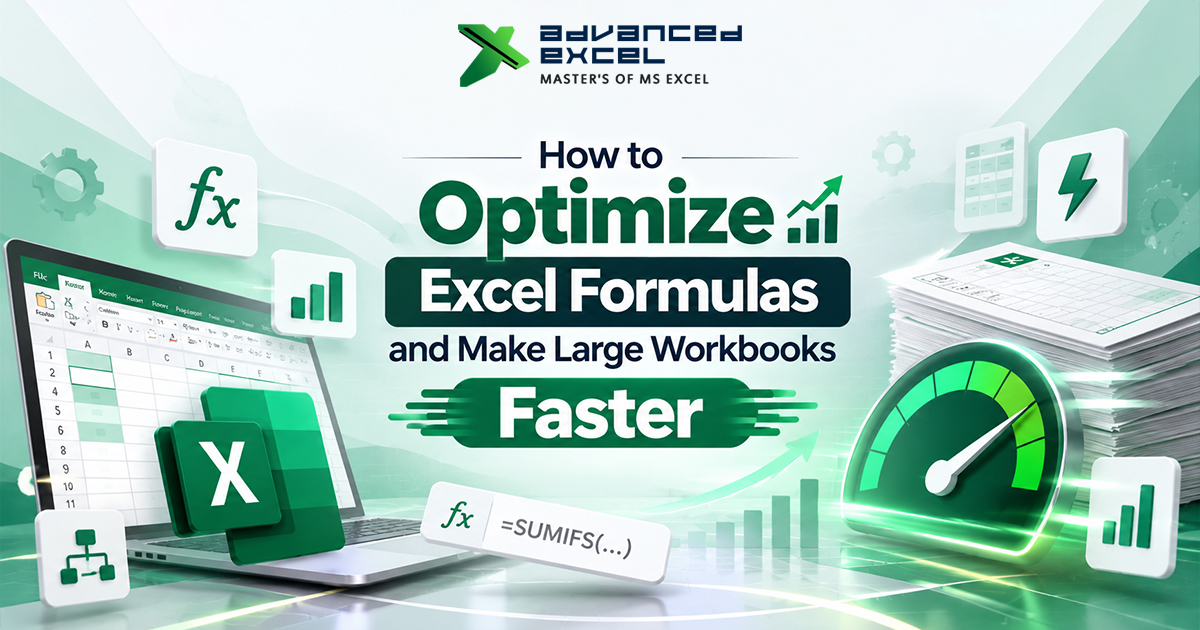
Excel is extremely powerful, but large workbooks can become slow over time.
A file that once opened instantly may eventually take several seconds or even minutes to open, calculate, save, or respond to simple actions. This usually happens when the workbook contains thousands of formulas, large data ranges, complex lookups, excessive formatting, or calculations that Excel has to repeat unnecessarily.
The good news is that you do not always need a new computer or a completely redesigned workbook to solve the problem.
In many cases, improving the way formulas are written and data is structured can make a noticeable difference.
In this guide, we will look at practical ways to optimize Excel formulas and improve the performance of large Excel workbooks. If you want to strengthen your formula-writing and data-analysis skills, you can also explore Advanced Excel & VBA Macros Online Training.
Why Do Large Excel Workbooks Become Slow?
Excel performance can be affected by several factors.
Common causes include:
- Too many formulas
- Complex formulas repeated thousands of times
- Volatile functions
- Full-column references
- Excessive conditional formatting
- Large lookup ranges
- Unnecessary calculations
- Too many external links
- Large amounts of unused formatting
- Complicated workbook structures
The problem is often not one individual formula. It is the combined calculation workload of the entire workbook.
What Does Excel Do When a Formula Changes?
When you change a value in Excel, the application may need to recalculate formulas that depend on that value.
For a small worksheet, this happens almost instantly.
However, imagine a workbook containing:
- 100,000 rows
- 20 formula columns
- Multiple lookup formulas
- Several PivotTables
- Conditional formatting
- External links
A single change can potentially trigger a large number of calculations.
This is why formula optimization becomes important as a workbook grows.
1. Avoid Unnecessary Full-Column References
One common formula-writing habit is using entire columns when only a specific range is required.
For example:
=SUMIF(A:A,”Delhi”,B:B)
This tells Excel to consider the entire columns.
If your actual data only exists between rows 2 and 50,000, a more targeted formula could be:
=SUMIF(A2:A50000,”Delhi”,B2:B50000)
The difference may not be noticeable in a small file, but when hundreds or thousands of formulas use full-column references, the calculation workload can increase.
Use ranges that are appropriate for your actual dataset whenever practical. For users working with complex formulas and large datasets, building stronger Advanced Excel skills can also help improve spreadsheet efficiency.
2. Be Careful With Volatile Functions
Some Excel functions recalculate more frequently than ordinary formulas. These are known as volatile functions.
Examples include:
- NOW()
- TODAY()
- RAND()
- RANDBETWEEN()
- OFFSET()
- INDIRECT()
Using a few of these functions is not necessarily a problem.
The issue occurs when volatile functions are used extensively across a large workbook.
For example, if thousands of cells contain formulas involving volatile functions, Excel may perform a large number of recalculations whenever the workbook changes.
Where possible, consider whether a non-volatile alternative can achieve the same result.
3. Reduce Unnecessary Formulas
More formulas do not always mean a better workbook.
Suppose you have 100,000 rows and several columns containing formulas that are only needed for a small portion of the data.
Ask yourself:
- Is every formula necessary?
- Can some calculations be performed once instead of repeatedly?
- Can a result be stored as a value when it no longer needs to change?
- Can the calculation be moved to Power Query?
Removing unnecessary calculations can improve both performance and maintainability.
4. Use Excel Tables for Structured Data
Excel Tables can make large datasets easier to manage.
Instead of working with constantly changing cell ranges, you can convert your data into a Table using:
Insert ? Table
Tables provide structured references and automatically expand when new records are added.
For example, instead of:
=SUM(B2:B50000)
you may work with a structured reference such as:
=SUM(SalesData[Amount])
Tables can also make formulas easier to understand and maintain.
5. Optimize Lookup Formulas
Lookup formulas are commonly used in business spreadsheets.
For example, you may need to retrieve:
- Employee department
- Product price
- Customer location
- Sales target
- Product category
Modern Excel versions provide functions such as XLOOKUP, which can make lookup formulas easier to read and maintain.
For example:
=XLOOKUP(A2,EmployeeID,Department,”Not Found”)
However, the function itself is only part of the performance equation.
The size of the lookup ranges, number of formulas, and workbook structure also matter.
Avoid unnecessarily large lookup ranges when the dataset is much smaller.
6. Avoid Repeating the Same Calculation
Consider a workbook where the same complex calculation appears in hundreds or thousands of formulas.
For example, imagine a long formula calculating a sales adjustment, and that formula is repeated across 50,000 rows.
If the same intermediate result is used multiple times, you may be able to calculate it once and reference the result.
This can make formulas:
- Easier to understand
- Easier to troubleshoot
- Potentially faster to calculate
Excel’s LET function can also help make complex formulas more efficient and readable by assigning names to repeated calculations.
For example:
=LET(price,A2,quantity,B2,price*quantity)
Instead of repeating the same expressions multiple times, you can calculate them once and reuse them within the formula.
7. Use LET for Complex Formulas
The LET function is particularly useful when a formula contains repeated calculations.
For example, a long formula may calculate the same lookup or mathematical expression several times.
With LET, you can assign a name to the calculation.
A simplified example:
=LET(total,A2*B2,total*10%)
Here, the calculated total is stored as total and then reused.
This can improve formula readability and, in appropriate situations, reduce repeated calculations.
8. Consider Power Query for Repetitive Data Processing
Not every task needs to be handled with formulas.
If your workbook repeatedly performs tasks such as:
- Combining files
- Cleaning columns
- Removing duplicates
- Splitting text
- Changing data types
- Merging datasets
- Filtering records
Power Query may be a better solution. You can also learn more about how Power Query and Power Pivot work together in Excel.
Instead of maintaining hundreds of formulas for data cleaning, you can create a repeatable transformation process.
This can make a workbook easier to maintain and reduce unnecessary worksheet calculations.
9. Reduce Excessive Conditional Formatting
Conditional Formatting is useful for highlighting important information.
However, applying large numbers of rules across very large ranges can affect workbook performance.
For example, applying several conditional formatting rules to an entire column when only 10,000 rows contain data may create unnecessary workload.
Review your conditional formatting rules regularly.
Remove rules that are no longer required and keep the applied ranges as focused as possible.
10. Avoid Excessive Use of INDIRECT and OFFSET
INDIRECT and OFFSET can be useful in dynamic Excel models, but they should be used carefully in large workbooks.
Both functions are volatile, which means they can contribute to frequent recalculation.
Before using them extensively, consider whether another approach can achieve the same result.
Modern Excel functions and structured references may provide simpler alternatives depending on the requirement. For more examples of advanced Excel formulas and functions, see this guide to Advanced Excel skills and formula techniques.
11. Keep External Links Under Control
Large workbooks sometimes depend on information stored in other Excel files.
External links can make a workbook more complicated because Excel may need to update information from other sources.
Review your workbook for unnecessary external links.
You can check external connections through Excel’s data and link management features and remove references that are no longer needed.
12. Use Manual Calculation Carefully
Excel normally uses automatic calculation.
For very large workbooks, temporarily switching to manual calculation can sometimes help while making major changes.
You can find calculation options under:
Formulas ? Calculation Options
However, manual calculation should be used carefully.
If calculation is set to manual, formulas may not immediately update when source data changes.
Always remember to recalculate the workbook before finalizing or sharing important results.
13. Remove Unused Rows, Columns and Formatting
Sometimes a workbook appears large even though the actual dataset is relatively small.
This can happen because formatting has been applied to thousands of unused rows or columns.
Unnecessary formatting can increase file size and contribute to workbook performance issues.
Review worksheets for:
- Unused formatting
- Unnecessary cell styles
- Excessive borders
- Unused rows
- Unused columns
- Duplicate formatting rules
Keeping the workbook clean can make it easier to manage.
14. Avoid Storing Everything in One Worksheet
Putting an entire business process into a single worksheet can make the file difficult to manage.
Instead, consider separating information logically.
For example:
Sheet 1: Raw Data
Sheet 2: Calculations
Sheet 3: Lookup Tables
Sheet 4: Dashboard
A structured workbook is easier to troubleshoot and maintain. For larger analytical models, you can also explore Power Pivot and DAX for Excel data modeling.
The goal is not to create dozens of worksheets, but to separate different types of information where it makes sense.
15. Use Helper Columns When They Improve Clarity
Some users try to create one extremely complicated formula because they believe fewer columns automatically means better performance.
That is not always true.
A few well-designed helper columns can make a workbook easier to understand and troubleshoot.
For example, instead of one huge formula that performs multiple operations, you might use:
Column A: Clean Customer Name
Column B: Customer Category
Column C: Sales Amount
Column D: Commission
This can make the calculation process much easier to audit.
Example: Improving a Slow Sales Workbook
Imagine a sales workbook with 80,000 records.
Each row contains:
- Date
- Customer
- Product
- Region
- Quantity
- Revenue
The workbook also contains multiple formulas for:
- Product lookup
- Region lookup
- Commission calculation
- Monthly classification
- Sales category
If each formula uses unnecessarily large ranges and repeated calculations, the workbook may become slow.
A better approach could include:
- Convert the source data into an Excel Table.
- Use appropriate lookup ranges.
- Replace repeated calculations with LET where useful.
- Move repetitive data cleaning to Power Query.
- Remove unnecessary conditional formatting.
- Reduce unused formatting.
- Review external links.
- Separate raw data from reporting calculations.
The result can be a cleaner and more manageable workbook. If your work also involves recurring reports and visual analysis, Excel dashboards can help turn structured workbook data into interactive reports.
How to Find What Is Making Your Excel File Slow
Before changing formulas randomly, identify the actual problem.
Ask these questions:
Is the file slow to open?
Check for:
- External links
- Large formulas
- Excessive formatting
- Large objects
- Complex workbook calculations
Is the file slow when entering data?
Look for:
- Large formula ranges
- Conditional formatting
- Volatile functions
- Complex dependencies
Is saving slow?
Review:
- File size
- External connections
- Large used ranges
- Objects and images
- Excessive formatting
Is calculation slow?
Focus on:
- Formula complexity
- Number of formulas
- Volatile functions
- Lookup ranges
- Repeated calculations
Excel Formula Optimization Checklist
Before finalizing a large Excel workbook, review the following:
- Are full-column references necessary?
- Are there unnecessary formulas?
- Are volatile functions used excessively?
- Can repeated calculations be simplified?
- Can LET improve complex formulas?
- Are lookup ranges unnecessarily large?
- Can Power Query handle repetitive transformations?
- Is conditional formatting applied to unnecessarily large ranges?
- Are there unnecessary external links?
- Does the workbook contain unused formatting?
- Are calculation settings appropriate?
- Is the workbook logically organized?
Frequently Asked Questions
Why is my Excel workbook so slow?
Large numbers of formulas, complex calculations, volatile functions, excessive formatting, conditional formatting, external links, and large datasets can all contribute to slow performance.
Does using fewer formulas make Excel faster?
Not always, but removing unnecessary calculations can reduce the amount of work Excel needs to perform.
Are full-column references bad in Excel?
They are not always bad, but they can increase the calculation workload when used extensively in large workbooks.
Does XLOOKUP make Excel faster?
XLOOKUP can make lookup formulas easier to write and maintain, but workbook performance depends on factors such as the number of formulas, lookup ranges, and overall workbook design.
Can Power Query improve Excel performance?
Power Query can be useful for repetitive data-importing and transformation tasks, potentially reducing the number of worksheet formulas required for data preparation.
Should I use manual calculation mode?
Manual calculation can be useful temporarily with very large workbooks, but it should be used carefully because formulas may not update automatically.
Conclusion
A slow Excel workbook is not always a sign that Excel cannot handle the data. In many cases, the problem is caused by inefficient formulas, unnecessary calculations, oversized ranges, excessive formatting, or a workbook structure that has become complicated over time.
The most effective approach is to identify where the workload is coming from and then simplify it.
Start by reviewing unnecessary formulas and full-column references. Then look at volatile functions, lookup ranges, conditional formatting, external links, and repetitive data-processing tasks.
For larger projects, tools such as Excel Tables, LET, Power Query, and well-structured worksheets can help create a more efficient workflow. If you want hands-on training in these Excel techniques, explore the Advanced Excel & VBA Macros Online Classes.
The goal is not simply to make Excel calculate faster. A well-optimized workbook should also be easier to understand, easier to maintain, and less likely to produce errors.
When performance and structure are considered together, even large Excel workbooks can remain responsive and manageable.